AI and Robotics Transform the Future of Healthcare
Medical devices on display at this year's China International Import Expo in Shanghai are taking on tasks that once depended heavily on skilled hands and experienced eyes.
From laboratories to operating rooms, advances in automation, artificial intelligence and robotics are changing how medical professionals work, helping turn complex procedures into more precise and streamlined processes.
The Intuitive Fosun booth featured da Vinci 5, the latest surgical robot, which debuted in China with a sense of touch.
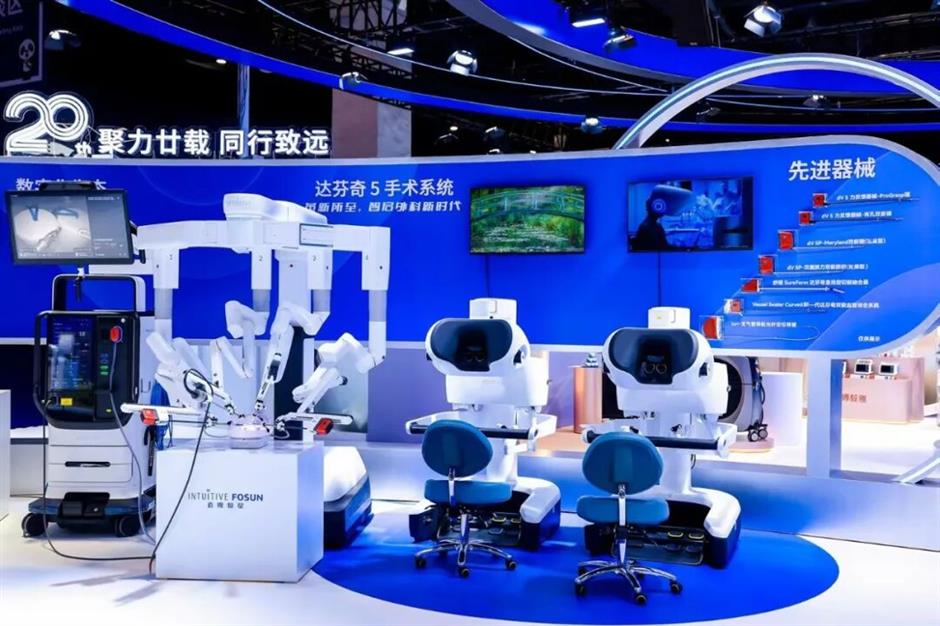
For decades, robotic surgery has relied largely on high-definition, three-dimensional images to guide surgeons, who operate instruments through a console without directly feeling the pressure applied to human tissue.
Force Feedback technology in Da Vinci 5 lets surgeons feel resistance through the controls while measuring the forces exerted during surgery.
"Since we introduced robotics to the industry and launched our first products 30 years ago, we have lacked haptic feedback and the ability to measure forces," said Dave Rosa, Chief Executive Officer and Member of the Board of Directors, Intuitive Surgical, and Chairman of the Board, Intuitive Fosun. "We have been working on this technology for decades."
The system incorporates more than 150 design innovations, including greater computing power, improved visualization and workflow enhancements designed to support future artificial intelligence applications.
Da Vinci 5 is undergoing regulatory review in China after entering the country's special review pathway for innovative medical devices in February.
Intuitive Fosun, a joint venture between US-based Intuitive and Fosun Pharma, is also displaying its da Vinci SP single-port surgical system, the locally manufactured da Vinci Xi, and the Ion robotic bronchoscopy platform.
The company is celebrating 20 years since da Vinci entered China. By September, over 520 da Vinci and Ion systems had been installed in China, serving over one million patients.
China is also taking on a larger role in the company's plans beyond sales and manufacturing.
"The R&D ecosystem here in China is strong, and we want to take advantage of that by establishing some of our R&D capabilities locally," Rosa said.
He pointed to China's engineering talent, supply chain expertise and advances in robotics, including humanoid robots, as potential sources of innovation.
While surgical robots are bringing greater precision to the operating room, another wave of automation is transforming the work that happens much earlier in medical research.
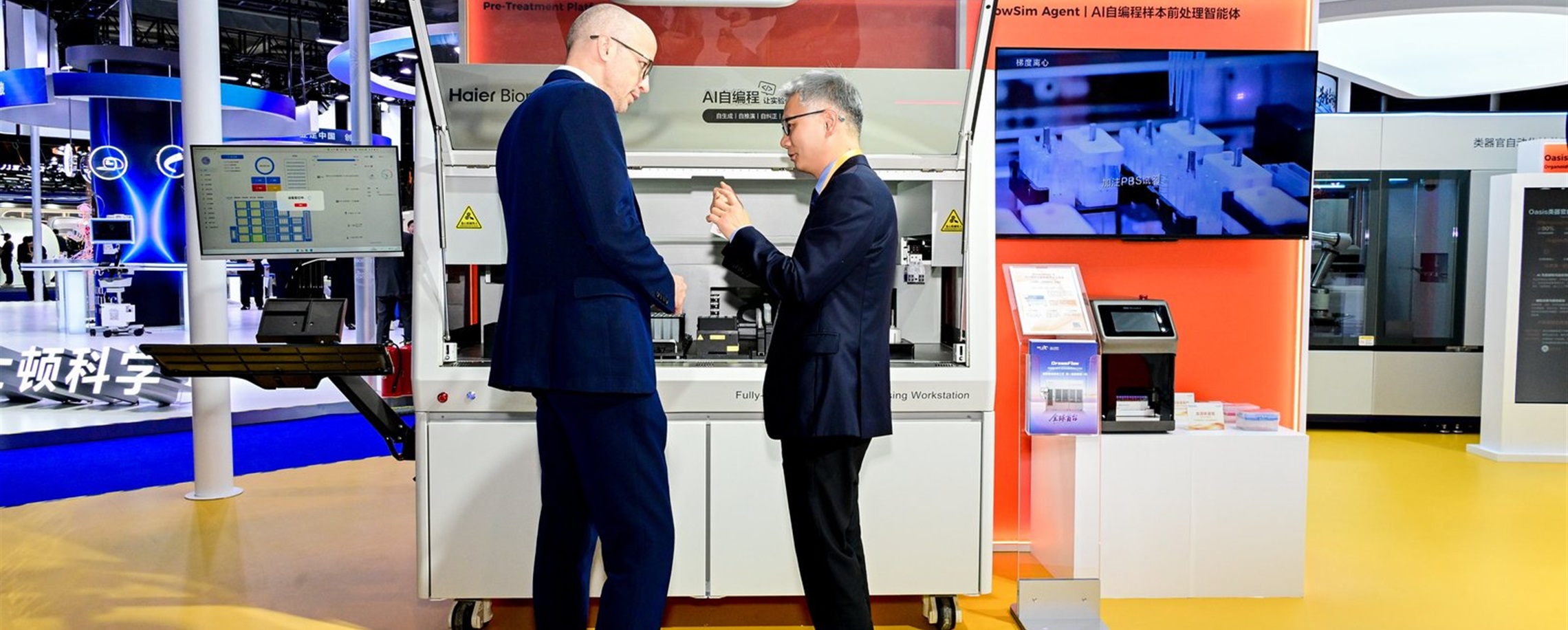
At Haier Biomedical, the focus is on making laboratory processes faster, more consistent and less dependent on manual operations.
The company is showcasing DreamFlow E, an AI-powered workstation that automates sample dispensing, extraction and purification – procedures that traditionally require considerable manual effort.
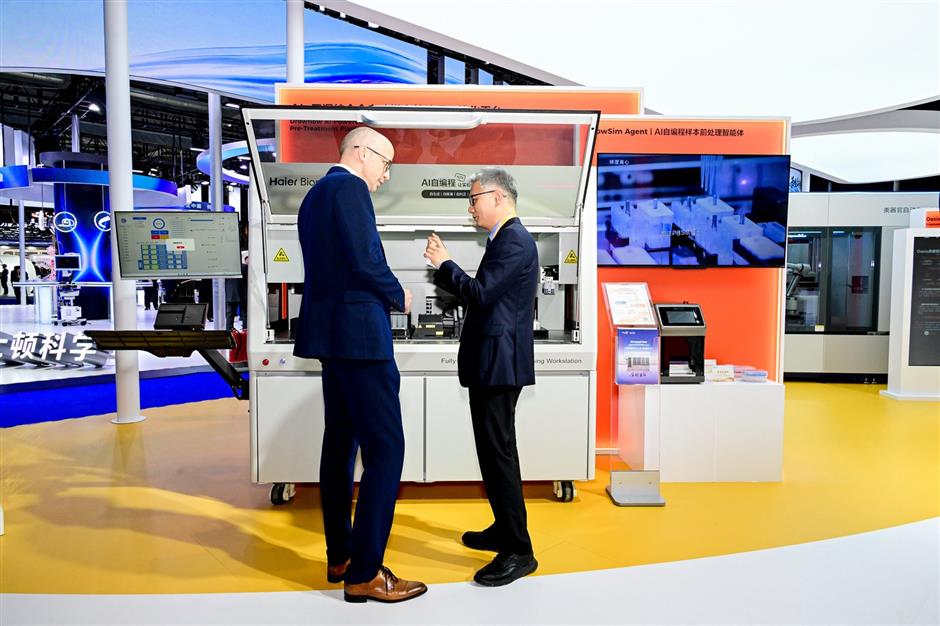
Researchers can enter experimental requirements in natural language, allowing the system to generate and validate workflows before automated equipment carries out the tasks.
"We're, as a matter of fact, a 'pick-and-shovel supplier' to innovative drug developers, providing equipment and technologies that underpin pharmaceutical research," said Wang Wenming, general manager of Overseas Markets at Haier Biomedical.
Biomedical research is becoming more automated with the Oasis automated organoid culture and drug-testing workstation.
Organoids are miniature, three-dimensional tissue models grown from cells that reproduce some characteristics of human organs. They allow scientists to study diseases and assess how these laboratory models respond to different medicines, offering new possibilities for more personalized drug testing.
The Oasis system integrates organoid cultivation, drug screening and AI-assisted analysis, allowing multiple drugs and concentrations to be tested in parallel while reducing manual operations and improving experimental consistency.
Beyond laboratory automation, precise temperature control is another important part of biomedical research and drug development.
Haier Biomedical is also displaying an ultra-low-temperature storage system powered by its InfiniCool Stirling cooling technology, with adjustable temperatures ranging from minus 20 to minus 100 degrees Celsius.
The equipment is designed to accommodate different storage requirements for biological samples and pharmaceutical materials, including those used in cell therapy and drug development.
The growing use of intelligent systems is also changing how information gathered during diagnosis can guide treatment.
Siemens Healthineers is launching a photon-counting CT-guided PCI solution in China. PCI is a minimally invasive approach to opening narrowed or blocked coronary arteries.
Photon-counting CT provides detailed three-dimensional images of blood vessels, including information about plaque and the extent of narrowing.
The German medical technology company's new solution brings that information directly into the catheterization laboratory, where physicians perform the intervention.
By linking preoperative CT analysis with live angiography, doctors can examine complex lesions, plan procedures and use previously acquired imaging information to help guide the positioning of stents.
The system combines Siemens' photon-counting CT capabilities with its ARTIS genio floor angiography platform, which incorporates AI-enabled imaging technologies.
The approach seeks to connect diagnosis and treatment, enabling physicians to utilize information gathered prior to the procedure more effectively.
For medical technology companies, however, more sophisticated equipment also raises a familiar question: how to measure its value beyond the cost of the technology itself.
Rosa said the upfront expense of robotic surgery could be higher than that of conventional open surgery, but a broader assessment should also consider hospital stays, complications and recovery times.
"As a healthcare system, we have to get good at measuring value, not just cost," he said.
The growing use of AI, imaging and sensors is also opening up new possibilities for robotic surgery.
Rosa compared the evolution of surgical robots to that of cars, which have gradually gained sensors and automated features to help drivers avoid accidents. Similar technologies, he said, could provide surgeons more information during operations, from the movement of anatomical structures to the forces applied to tissue.
In time, surgical systems may even be able to perform certain movements autonomously, although Rosa cautioned that fully autonomous surgery remains a distant prospect.
"We're still far from achieving autonomous surgery, but I believe it's a feasible direction for the future," he said. "We just need to make sure it delivers real benefits and better outcomes for patients."
Editor: Yao Minji
In Case You Missed It...
 Nov 9, 2026