Magnitude-7.0 Earthquake Kills 16 in Xizang's Nagqu, Damaging 339 Homes
A magnitude-7.0 earthquake struck Baqen County in Nagqu City, southwest China's Xizang Autonomous Region, at 10:33pm on Thursday, killing 16 people and injuring 46, local authorities said.
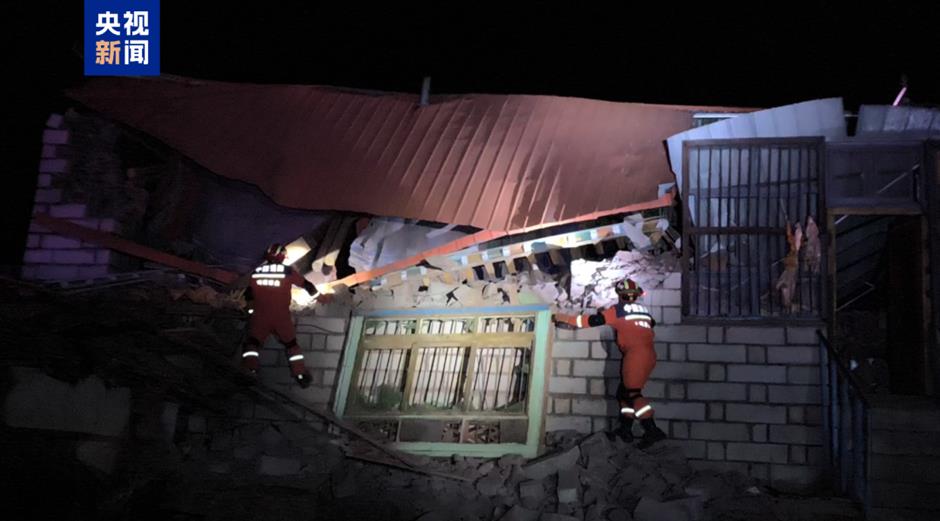
As of 5:20am on Friday, 11 of the injured were in serious condition and 35 had minor injuries, the Nagqu earthquake relief headquarters told China Central Television. A total of 339 households had houses collapse or suffer damage, and 20 livestock pens were damaged. Officials said the toll was still being verified.
The China Earthquake Networks Center measured the quake at a depth of 10 kilometers, with the epicenter in Maru Township, about 70 kilometers from the county seat. The area sits at an average altitude of about 4,800 meters and is sparsely populated, according to the Ministry of Emergency Management.
It is the strongest earthquake in China so far this year and the country's first of magnitude 7 or above since a magnitude-7.1 quake hit Wushi County in Xinjiang on January 23, 2024.
Strong shaking was felt across Nagqu, in parts of Qamdo, in Lhasa and in Yushu in neighboring Qinghai Province. In Qamdo's Banbar and Dengqen counties, residents of high-rise buildings moved outdoors and schools gathered students on sports grounds.
In Baqen's county seat, a hotel owner surnamed Wang told reporters he was on an upper floor when the quake hit and took cover at once. "The whole building was shaking," he said, adding that plates and bowls were falling in a friend's restaurant. He ran downstairs with his guests once the shaking eased, and no one at the hotel was hurt.
The building was left with several visible cracks. Afraid of aftershocks, guests waited outside in heavy clothes through the cold night rather than go back in.

At 2:10am on Friday, an advance team of eight firefighters from the Baqen brigade reached the quake zone to search collapsed houses. Ten minutes later, they pulled one trapped person out alive in a village in Maru Township, the local fire and rescue service said.
The Xizang fire and rescue corps has sent 347 rescuers, 82 fire engines and 15 search dogs, along with more than 4,200 pieces of equipment. Regional police dispatched more than 300 officers to check on injuries and damaged homes and to move villagers to open ground.

Xizang launched a Level-II emergency response, the second-highest in its four-tier system. At the national level, the State Council's earthquake relief headquarters and the Ministry of Emergency Management activated a Level-IV response, the lowest of four tiers, and sent a work team to the area. Hu Changsheng, Party secretary of the Xizang Autonomous Region, led officials to the disaster zone overnight.

The quake also disrupted traffic on the Qinghai-Xizang Railway. The railway operator temporarily closed sections of the line while tracks and equipment were inspected, and trains already on the move stopped at safe locations. Several trains bound for Golmud were delayed.
A string of aftershocks followed, including magnitude-4.3 and 4.2 tremors within 40 minutes of the main shock, according to the China Earthquake Networks Center.
The quake came less than two years after a magnitude-6.8 earthquake hit Dingri County in Xizang's Xigaze on January 7, 2025, killing 126 people.
Editor: Wang Xiang
In Case You Missed It...

 Oct 22, 2026